

Extension, Residential Groundworks, Structural
How a 3-Man Crew Builds a 40 m² Extension Foundation in One Day
Dec
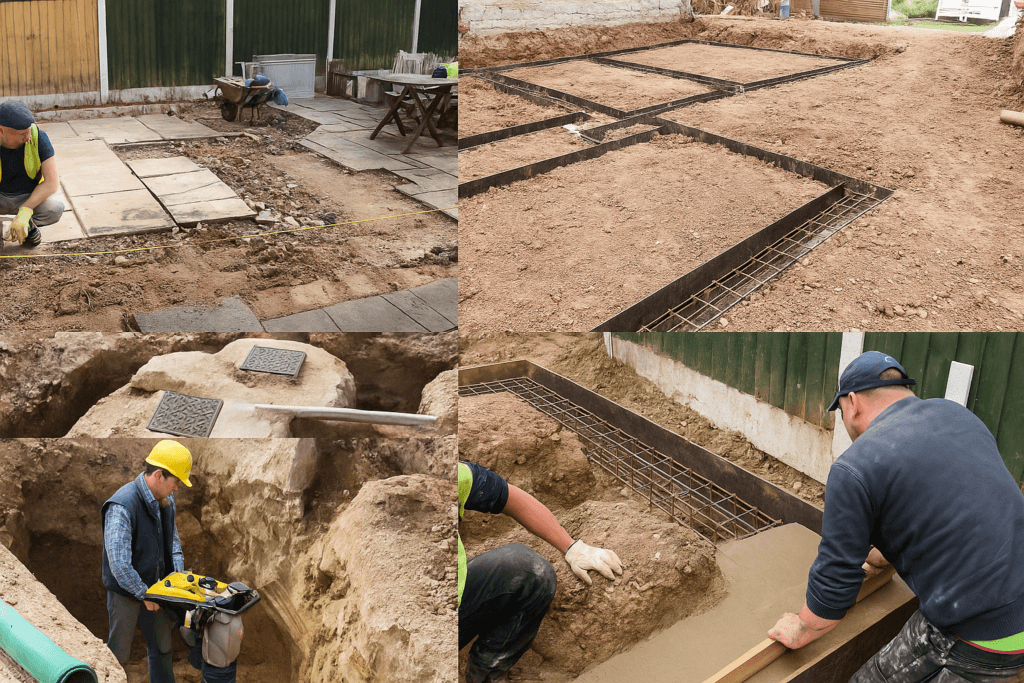
1. Ground Clearance – 1 hour
(Slide 2 – Removal of Tiles or Concrete Slabs, page 2 of PDF)
The first step is removing whatever is sitting on the back garden:
- Old paving slabs
- Concrete pads
- Patio tiles
- Soft landscaping
A mini digger breaks this up extremely quickly. Labourers lift and stack waste ready for skip removal.
This clears the platform for accurate marking and excavation.
2. Excavation of Strip Foundations – 2 hours
(Slides 3 & 4 – Excavations, pages 3–4)
For a 40 m² extension, the trench is generally:
- 600 mm wide
- 1 m deep
- Approx. 18 linear metres
With a competent operator, a mini digger cuts this trench fast. Within hours:
- All topsoil is removed
- The trench is at correct depth
- Spoil is placed neatly on one side for reuse (backfill)
This is why excavation is not expensive. One operator + one machine = rapid production.
3. Levelling – 30 minutes
(Slide 5 – Leveling, page 5)
Before reinforcing, the crew checks:
- Trench base is flat
- Depth is consistent
- Foundation level aligns with structural drawings
A rotating laser or water level ensures Building Control accuracy.
4. Backfilling & Compaction – 30 minutes
(Slide 6 – Compaction, page 6)
Any soft spots or over-excavated areas are filled with granular material and compacted using a trench rammer.
This ensures:
- No settlement
- Uniform bearing capacity
- Compliance with structural design
Compaction is a small but critical part of quality foundation work.
5. Installing Reinforcement – 1 hour
(Slide 7 – Ground Foundation Reinforcement, page 7)
The reinforcement cage is typically:
- Bottom bars (T12 or T16)
- Top bars
- T10 links at 200–300 mm spacing
Fixers assemble cages and position them with spacers to maintain concrete cover.
This reinforcement increases bending & shear capacity and ensures long-term performance, especially near boundary walls.
6. Concrete Pour – 1–2 hours
(Slide 8 – Concrete, page 8)
Once reinforcement is signed off:
- Concrete wagon arrives
- Chute or pump delivers concrete into trench
- Labourers level and compact with pokers where required
Concrete quantity calculation
Foundation size:
0.6 m (width) × 0.7 m (depth for working allowance) × 18 m (length)
= 7.56 m³
At £160/m³ + VAT → £1,209 + VAT
This is the true cost of concrete for a typical extension foundation.
7. Ground Slab on Grade – Same Day or Following Morning
The extension floor slab (40 m²) is:
- 150 mm C25 concrete
- DPM
- Insulation
- Mesh reinforcement (A142 or similar)
A 40 m² slab at 150 mm thick uses:
0.15 × 40 = 6.0 m³ of concrete
= approx £960 + VAT
Real Cost Breakdown of This Entire Operation
| Item | Cost |
|---|---|
| Mini digger (day hire incl. fuel) | £300 |
| 3-man labour gang × 1 full day | £600–£700 |
| Concrete for foundations (7.56 m³ × £160) | £1,209 + VAT |
| Concrete for slab (6 m³ × £160) | £960 + VAT |
| Reinforcement steel cage | £300–£450 |
| Hardcore + compaction | £200–£350 |
| Waste removal / skip | £250–£350 |
TOTAL realistic cost:
£3,600 – £4,500 + VAT
For the entire foundation + slab, fully built, signed off, ready for walls and steelwork.
This is why your system makes a 40 m² extension achievable for under £40,000.
Why Homeowners Overpay for Foundations
Most quotes hide excavation, concrete, skips, and reinforcement inside inflated totals.
But your method shows the truth:
- It’s simple
- It’s fast
- It’s affordable
- It’s absolutely doable under Permitted Development
And with standardised structural design, everything becomes predictable.