

Construction, RC Frame, Structural
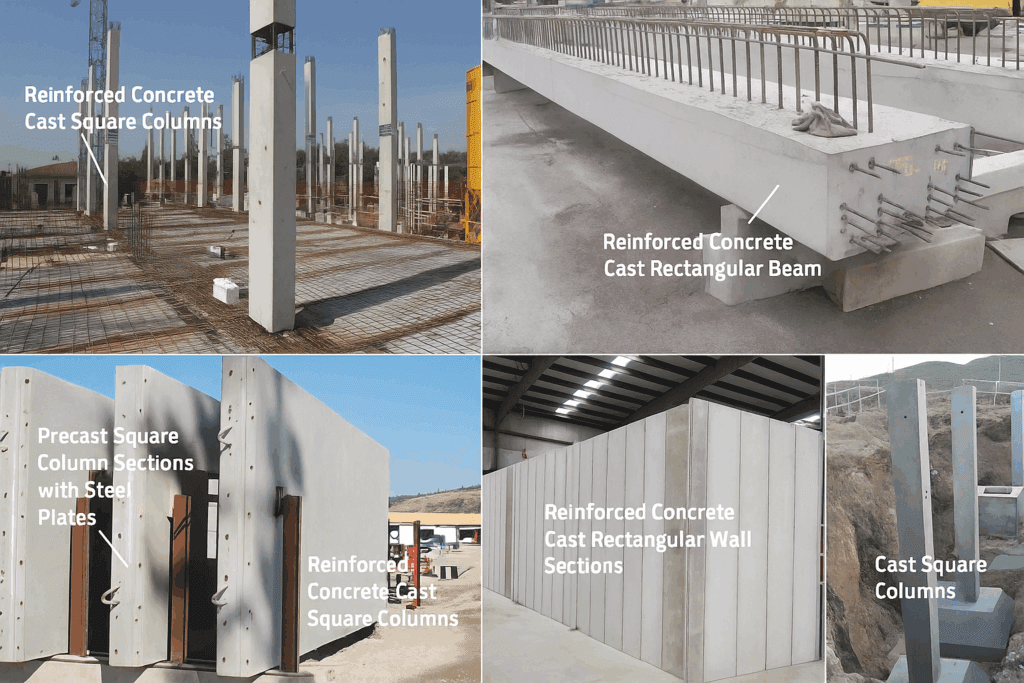
Casting Rectangular and Square Concrete Columns — Complete Method Statement
Nov
1. Scope and Purpose
The procedure applies to all reinforced concrete columns of rectangular or square cross-section. It defines how to prepare, cast, compact, cure, and inspect columns safely and in compliance with structural drawings and specifications.
The objective is to ensure every column is structurally sound, dimensionally accurate, and aesthetically uniform — meeting project tolerances for plumb, cover, and alignment.
2. Preparation and Safety Measures
Before any work starts, a full safety induction must be given to all operatives. Multilingual safety boards should be displayed, PPE (helmets, boots, goggles, gloves) must be worn, and adequate lighting arranged for night shifts.
The site should have barriers to separate casting zones, and welfare facilities like drinking water and first-aid access should be maintained.
3. Survey and Reinforcement Fixing
After floor slab completion, surveyors mark the column centerlines with a Total Station. The area beneath the column is cleaned and roughened for bonding.
Reinforcement cages — fabricated per approved drawings — are fixed and secured vertically.
Cover blocks ensure the correct concrete cover, while links and stirrups are tied as per the spacing schedule. The Quality Engineer inspects reinforcement before any formwork is placed.
4. Fixing and Aligning the Formwork
Formwork panels (usually steel or high-grade plywood systems like Doka or Peri) are assembled around the reinforcement. The arrangement must follow approved shop drawings, including waling supports (WU14) and tie-rods shown in Figures 2–4 of the document.
All corners use universal angle tie brackets to ensure square edges, while form-ties are positioned symmetrically to resist hydrostatic pressure during pouring.
The forms are tightened, aligned, and braced with adjustable props or scaffolding.
An air blower is used to remove dust, and form release agent is applied before concrete placement.
5. Concrete Pouring and Compaction
After inspection approval, concrete is poured using pumps or buckets in layers not exceeding 1.5 m in height. Continuous vibration prevents honeycombing and air pockets.
The pour sequence follows the approved Inspection Request (IR) and mix design.
The supervising engineer ensures that slump, temperature, and cube sampling are done during casting. If night work is required, additional lighting must be installed.
6. Curing and Striking Formwork
Immediately after demoulding, the column is cured using approved curing compound or wet hessian wrapping for at least seven days to achieve required strength.
Formwork is struck after the minimum period specified — typically nine hours for vertical forms — ensuring no early movement that could cause cracking or dimensional deviation.
7. Quality Control and Testing
Every stage is verified by QC Engineers against allowable tolerances:
- Verticality: h/500
- Dimensional deviation: ±5 mm (up to 600 mm section)
- Position tolerance: ±10 mm
Concrete cubes (150 mm × 150 mm × 150 mm) are tested at 7 days and 28 days as per BS EN 12390.
Rapid Chloride Permeability or Water Absorption tests may be added for durability assessment.
8. Final Notes
Casting rectangular and square concrete columns demands precision at every stage — from steel fixing to curing. The smallest oversight in cover, vibration, or striking time can compromise durability and alignment.
At Amtaar GC, our team applies this exact method across our London RC frame and superstructure projects, combining quality assurance with the latest Eurocode design and inspection standards.
✅ If your project involves RC frame construction or structural column casting, contact our engineering team for a complete design-and-build package — from rebar detailing to final QA certification.