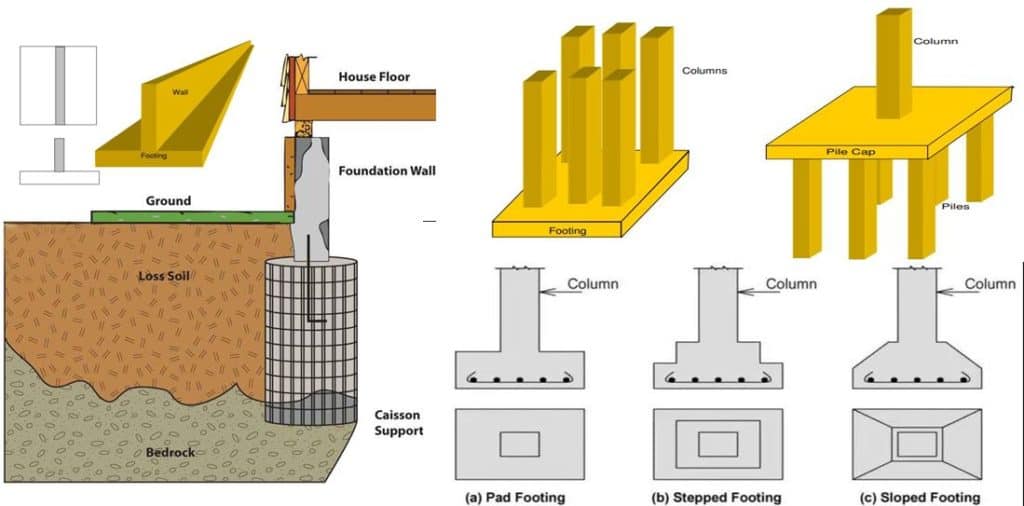
When people talk about soil bearing capacity, it often sounds complicated, full of charts, codes, and laboratory testing. But in real-world construction—especially small to medium-scale residential and commercial projects—engineers rely on practical experience, site behaviour, and conservative assumptions. That’s where the 5 ton/m² (≈100 kN/m²) rule comes from. It’s not random. It’s not optimistic. It’s […]
Tag Archives: Structural Engineering
Architectural canopies made from aluminium and glass are magnificent engineering achievements—but supporting them is one of the most complex structural problems any project can face. When a canopy spans tens of metres, is fully glass-clad, and projects outward from a curved façade, the challenge intensifies: where do you support this massive load without compromising the […]
Dock levellers are critical structural components in any logistics, warehousing, and loading-bay facility. Their function is simple: bridge the gap between a truck bed and the warehouse floor. However, the engineering behind them is complex, requiring precise structural modelling, load calculations, reinforced concrete design, and steel connection verification. This blog provides a detailed technical breakdown […]
Temporary hoist systems play a crucial role in high-rise construction, enabling the vertical movement of materials and personnel throughout the project lifecycle. Behind these towering mechanical lifts lies a precisely engineered structural support system — the temporary hoist platform — which demands rigorous analysis, high-grade materials, and strict adherence to international design codes. 1. Purpose […]
What is pile head treatment—and why it matters Pile head treatment prepares the top of each pile to bond cleanly with the blinding/raft and to transfer load without slip or weak laitance, while ensuring a watertight interface. A typical method statement sequences dewatering, safe exposure, accurate cut-off, controlled breaking, hand trimming for the final 200–300 […]
Building a watertight RC water tank isn’t just “another pour”—it’s a tightly sequenced operation where setting-out, waterstops, formwork, vibration, and QA all have to be right the first time. Below is a site-ready guide distilled from an approved Method Statement for Casting the Water Tank Walls, adapted to our London workflows. Scope & prerequisites Sequence […]
When you see a tower rise or a basement slab go down on time, safely, and within budget—it’s not luck. It’s the result of clear, auditable engineering design criteria agreed at the start. This document is the structural team’s “contract with physics”: it fixes the codes to follow, the materials and strengths to use, the […]
When people say “grouting,” they often mean anything from anchoring baseplates to sealing post-tension (PT) ducts. At AmtaarGC, grouting is a tightly controlled, test-backed process that protects durability, stiffness and long-term serviceability. Here’s how we do it on London projects, with the exact QA steps we put in our site packs. What is structural grouting? […]
External plastering is more than a “skim and go.” Done right, it protects your building envelope, delivers the façade finish you want, and prevents water ingress for years. Below is our AmtaarGC field-tested workflow, aligned with classic method statements for multi-storey buildings, and adapted for London sites (tight access, mixed substrates, and year-round weather). What […]
Raft (mat) foundations are our default solution for London’s mixed ground—spanning across the whole building footprint to spread loads evenly, control settlement, and simplify coordination of vertical elements (cores, shear walls, columns). Below is how we deliver rafts quickly, safely, and to spec—so your frame can rise without surprises. When we choose a raft Our […]
- 1
- 2